The Challenge
A CATOFIN reactor utilized a catalyst with an approximately two-year operating lifecycle. As the catalyst aged, deposits accumulated on its surface, gradually reducing activity and negatively impacting reactor performance and product yield.
To restore catalyst activity, operators periodically injected natural gas to generate heat and burn off accumulated deposits. However, determining the optimal regeneration dosage presented a significant operational challenge.
Applying too little natural gas resulted in incomplete regeneration and reduced process performance. Applying too much accelerated catalyst degradation, shortening catalyst life and increasing replacement costs.
Historically, operators relied on engineering experience and a detailed process simulation model to guide regeneration decisions. While the simulation provided valuable insights, it required significant computational time to generate a single recommendation, making it impractical for rapidly changing plant conditions.
The client needed a faster and more adaptive solution capable of recommending optimal regeneration strategies based on current operating conditions.
Our Solution
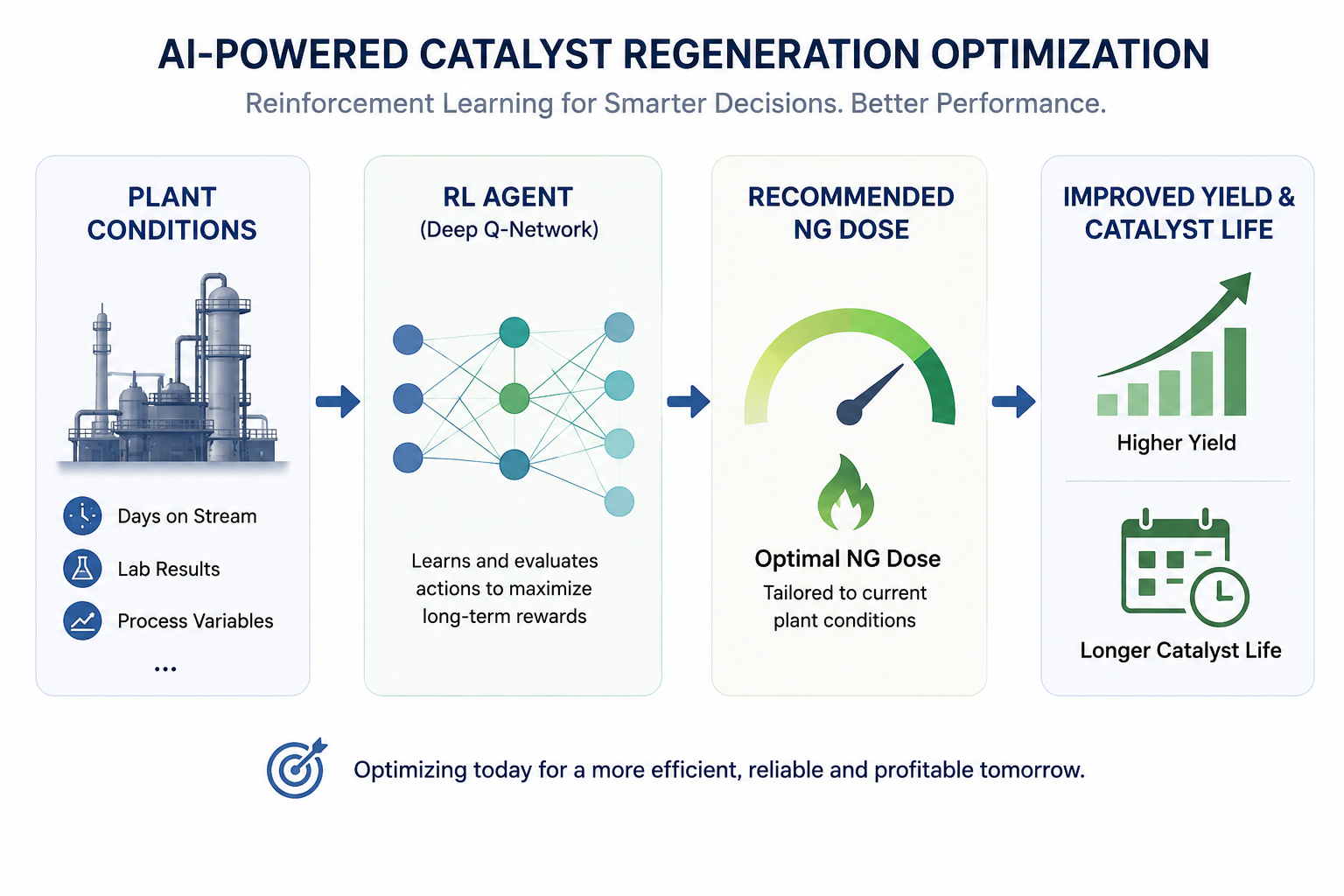
Nilmuda developed a Reinforcement Learning (RL)-based decision-support system that continuously evaluates plant conditions and recommends optimal catalyst regeneration dosage rates.
The solution was built around a Deep Q-Network (DQN), a reinforcement learning algorithm that learns optimal operating policies by exploring different actions and evaluating their long-term impact on process performance.
The RL agent considered plant operating conditions including:
- Days on stream
- Natural gas regeneration dosage
- Catalyst age indicators
- Laboratory analysis results
- Key process operating parameters
To train the agent, historical outputs from the client's existing simulation model were leveraged to build a multivariate surrogate model capable of rapidly estimating process outcomes.
This surrogate model served as the reward function for the RL environment, allowing the agent to evaluate thousands of operational scenarios without requiring computationally expensive simulation runs.
The reward structure balanced multiple objectives, including:
- Maximizing reactor yield
- Preserving catalyst lifespan
- Maintaining process stability
- Reducing unnecessary natural gas consumption
Through repeated exploration and learning, the agent developed an optimized operating policy capable of identifying regeneration strategies that delivered the best overall tradeoff between catalyst performance and catalyst longevity.
During deployment, the system received real-time plant operating data and generated recommended natural gas dosage rates tailored to current plant conditions.
The Outcome
The project transformed catalyst regeneration from a largely experience-driven process into a data-driven optimization strategy.
Key benefits included:
- Real-time regeneration recommendations based on current plant conditions
- Significant reduction in computational time compared to traditional simulation-based optimization
- Improved catalyst utilization throughout the catalyst lifecycle
- Enhanced operator decision-making through data-driven recommendations
- Better balance between catalyst performance and catalyst preservation
- Increased ability to respond to changing operating conditions
- Foundation for future closed-loop process optimization initiatives
By combining chemical engineering expertise with reinforcement learning, the client gained a practical decision-support tool capable of optimizing a complex, dynamic process that had historically relied on slow simulations and operator judgment.