Overview
Industrial processes are highly dynamic systems influenced by continuously changing operating conditions, process interactions, and time-dependent variables. Traditional optimization approaches often rely on static operating targets and operator experience, making it difficult to consistently achieve optimal performance under varying plant conditions.
At nilmuda, we combine data science with practical engineering expertise to develop customized process optimization solutions tailored to real industrial operations.
Our approach leverages advanced methodologies such as:
- Reinforcement Learning (RL)
- Markov Decision Processes (MDP)
- Dynamic process optimization
- Multivariable analysis
- Anomaly and sensitivity analysis
- Process variable impact assessment
These techniques allow us to model complex operational behavior, identify the variables that most strongly influence process performance, and generate optimized operating strategies that adapt to changing plant conditions.
Rather than applying generic models, we work closely with plant personnel, engineers, and operators to fully understand the process, operational constraints, and business objectives—ensuring solutions are practical, deployable, and aligned with real-world operations.
What Makes Industrial Optimization Challenging
Industrial unit operations are rarely static.
Key process variables such as:
- temperature
- pressure
- flow rate
- residence time
- catalyst activity
- feed composition
- heat transfer efficiency
continuously change over time and interact with one another in complex ways.
This creates significant challenges when attempting to automate or optimize operations using traditional rule-based approaches.
Our solutions are designed to account for:
- Dynamic operating conditions
- Time-dependent process behavior
- Equipment degradation and fouling
- Nonlinear relationships between variables
- Process disturbances and variability
- Operational and safety constraints
Real-World Scenario
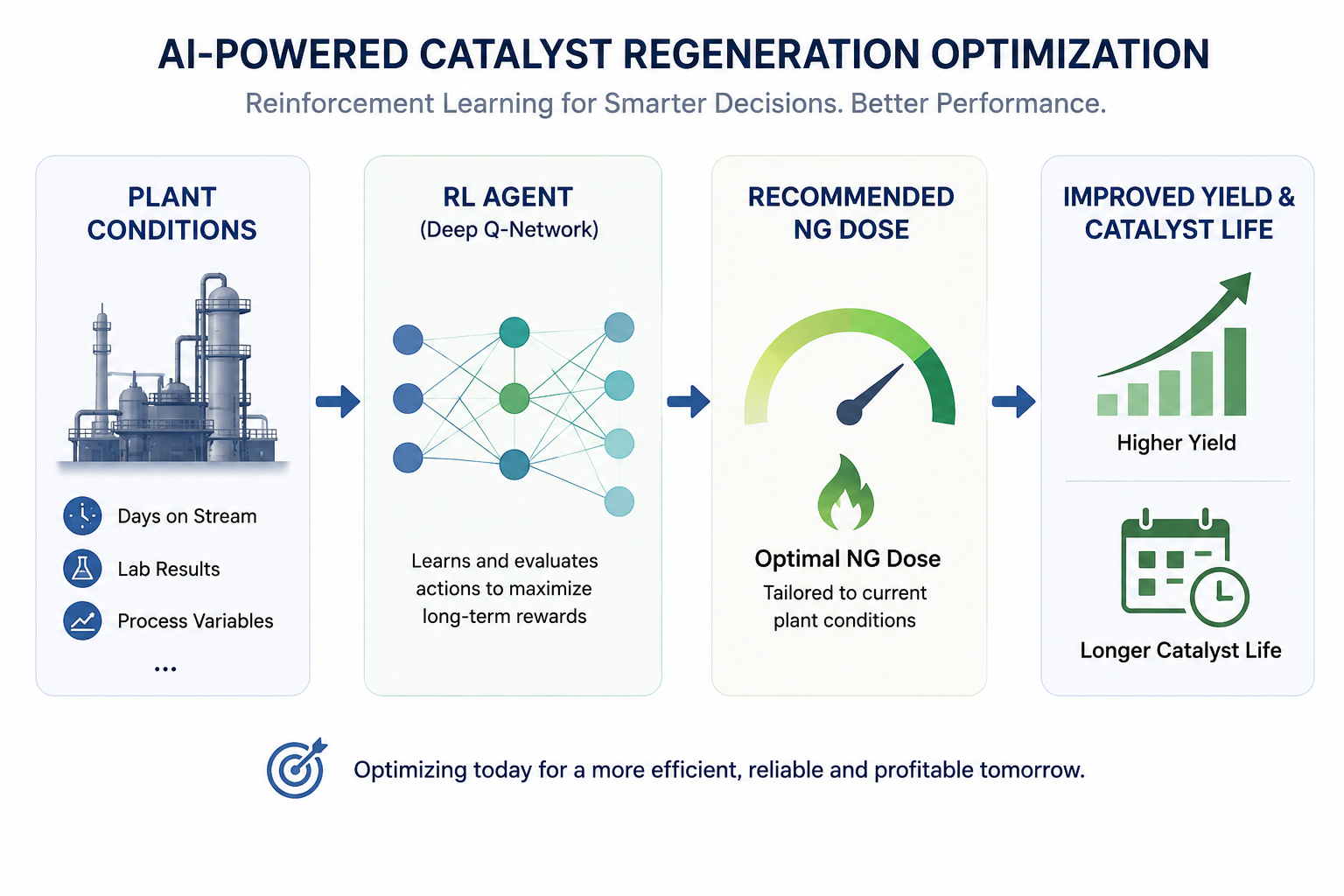
In a chemical processing operation, operators periodically inject natural gas to burn off deposits accumulated on the surface of a catalyst bed in order to restore reactor efficiency and improve product yield.
However, the process required careful balance:
- Applying too much natural gas risked damaging the catalyst and shortening its lifecycle
- Applying too little resulted in incomplete regeneration and reduced reactor performance
The challenge was further complicated by changing plant operating conditions, fluctuating feed characteristics, and evolving catalyst behavior over time.
To address this, we developed a Reinforcement Learning–based optimization framework capable of learning optimal operating policies under dynamic process conditions.
Using historical process data and operational constraints, the model continuously evaluated plant conditions and determined the optimal natural gas injection strategy to:
- Maximize reactor yield
- Preserve catalyst lifespan
- Reduce operational variability
- Improve process stability
The result was a more consistent and optimized regeneration strategy that balanced performance improvement with long-term catalyst health.
Our Approach
Engineering-Driven Collaboration
Successful optimization requires more than algorithms.
We work closely with your operators, engineers, and technical teams to:
- Understand process behavior and operational constraints
- Incorporate domain expertise into model development
- Validate optimization strategies against real operating conditions
- Deliver practical, implementable solutions—not theoretical models
Our combined expertise in engineering and data science allows us to bridge the gap between advanced analytics and real plant operations.