The Challenge
A wood pelleting facility relied heavily on drag chain conveyors to transport material throughout the production process. These conveyors represented a critical asset within the operation, where unexpected failures could disrupt material flow, reduce throughput, and lead to significant production losses.
The facility had vibration sensors installed on the conveyors, generating large volumes of operational data. However, the data was primarily used for monitoring and lacked predictive capabilities that could provide early warning of developing equipment issues.
In addition, maintenance teams faced challenges identifying recurring failure modes from historical maintenance records, making troubleshooting and root-cause analysis time-consuming and highly dependent on individual experience.
The client sought a solution that could proactively identify equipment degradation, reduce unplanned downtime, and improve maintenance decision-making.
Our Solution
Nilmuda developed an end-to-end predictive maintenance and condition monitoring solution that combined machine learning, vibration analytics, and AI-assisted troubleshooting.
The solution included:
- Development of machine learning models to continuously monitor conveyor health and detect early indicators of equipment degradation.
- Automated anomaly detection using vibration sensor data to identify abnormal operating conditions before failure occurred.
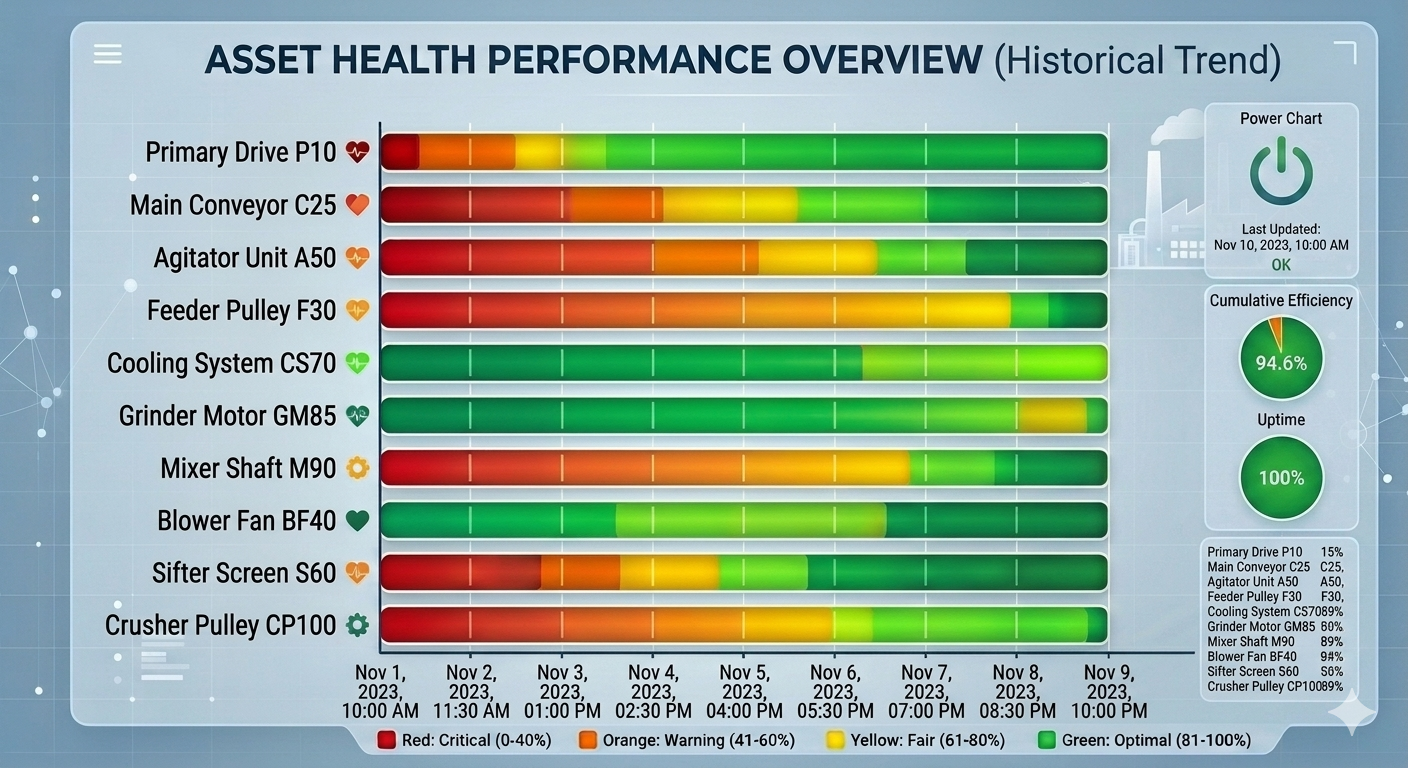
- Creation of condition monitoring dashboards providing real-time asset health visibility to maintenance and operations teams.
- Application of Natural Language Processing (NLP) and Non-Negative Matrix Factorization (NMF) to classify and identify recurring failure patterns from historical maintenance logs.
- Integration of a Retrieval-Augmented Generation (RAG) framework that leveraged historical maintenance records and operational knowledge to provide troubleshooting suggestions and accelerate root-cause analysis.
- Benefit-case analysis to quantify projected and realized business value and support management decision-making.
The Outcome
Outcome
The solution enabled maintenance teams to shift from reactive maintenance toward a proactive, condition-based maintenance strategy.
Key results included:
- ~65% reduction in unplanned downtime associated with critical drag chain conveyors.
- Earlier detection of developing equipment issues through continuous condition monitoring.
- Faster root-cause analysis through AI-assisted troubleshooting recommendations.
- Improved maintenance planning and resource allocation.
- Enhanced visibility into asset health through real-time monitoring dashboards.
- Identification of recurring failure modes from historical maintenance records, improving organizational knowledge retention.
- Successful presentation of projected and realized business benefits to senior leadership, supporting continued investment in data-driven reliability initiatives.
By combining machine learning, condition monitoring, and intelligent troubleshooting, the client improved asset reliability, reduced operational disruptions, and established a foundation for scalable predictive maintenance across additional critical equipment.